
Blog
PET Bottle Blowing Techniques in South Africa
Sep
PET Bottle Blowing Techniques
Have you ever thought about the process behind the plastic bottles we use every day? In this article, we’ll explore how PET bottle blowing techniques in South Africa work. We’ll see how these methods are essential for making bottles efficiently and with a nod towards sustainability.
We’re taking a closer look at PET bottle manufacturing in South Africa. We will highlight different methods and the key figures behind them. Innovations such as the ASB-12M and ASB-70DP series are boosting productivity. They’re also making the process greener. Join us as we dive into the fascinating world of bottle making.
Table of Contents
Key Takeaways
- Understanding PET bottle blowing techniques enhances our appreciation of the industry.
- Innovations like the 1.5-step “Cool Parison” method are reshaping production capabilities.
- Energy-efficient models, such as the ASB-12M, are setting new standards in production.
- Addressing challenges with PET air compressors is crucial for maintaining quality.
- Continuous operation is made possible with advancements in compressor technologies.
- Latest trends underscore the importance of sustainability within the blow moulding industry.
Introduction to PET Bottle Blowing Techniques
PET stands for Polyethylene Terephthalate. It’s a top thermoplastic used in making plastics, especially PET bottles. It’s chosen for its strong and recyclable qualities. These features make it preferred in various sectors in South Africa. The PET bottle blowing techniques play a big role in shaping these bottles. They affect the bottles’ final look and where they can be used.
Looking into these techniques shows us how much plastic bottle moulding has progressed. Modern machines can now produce up to tens of thousands of bottles every hour. This leap in production meets not just local, but global demand. It also supports sustainability efforts worldwide.
Understanding PET bottle making shows us the importance of balance. It’s about keeping quality high while caring for our planet. For example, preforms in blow moulding follow strict rules. They must meet certain criteria for recycled content and weight. This ensures the final bottles are top quality. Keeping a steady temperature during production is crucial too. It makes sure the bottles are stable and strong.
In South Africa, PET bottles are everywhere, especially in beauty products like shampoos. By understanding this, we can choose packaging that helps cut down plastic waste. For more on these materials and their benefits, check out the advantages of PET bottles.
The Bottle Blowing Process
The bottle blowing process is a complex journey with several key stages. These stages ensure PET plastic bottles are made perfectly. They show us the skilled art of making bottles and how each step needs to be precise.
We look at the process in important stages next.
Steps in the Blow Moulding Process
The blow moulding process has three main steps: preform moulding, blow moulding, and bottle cooling. First, the PET resin turns into a preform. Then, we heat the preform so it’s ready to expand when we blow air into it.
This step is important because it affects the bottle’s quality. Next, in the blow moulding phase, we put the heated preform in a mould. This is where it gets its shape by blowing air into it. Paying close attention here is key, as any mistakes can make the bottles turn out wrong. This process allows for making various bottle designs.
The Importance of Preform Heating
Preform heating is crucial in making a good bottle. It ensures the bottle won’t have weak spots that could make it crack. Machines like the JND-880 and HM-1500 help keep the temperature just right. This makes sure each preform is heated well for moulding.
Understanding blow moulding also helps us see how to be more sustainable with PET bottles. By recycling, we can turn used bottles into new items. We can learn about melting PET bottles here. This helps us contribute to environmental conservation.
Types of PET Bottle Manufacturing Techniques
We see two main methods in PET bottle making: Extrusion Blow Moulding and Injection Stretch Blow Moulding. Each has its own benefits, fitting different needs.
Extrusion Blow Moulding
Extrusion Blow Moulding (EBM) is widely used for big containers. It works by pushing molten plastic through a die to form a parison. This parison is then blown up inside a mould. It’s fast, perfect for making lots of bottles quickly. That’s why many big manufacturers use special PET Bottle Machinery for EBM. It boosts productivity.
Injection Stretch Blow Moulding
Injection Stretch Blow Moulding (ISBM) is great for detailed and strong bottles. It mixes injection moulding for the initial shape with blow moulding for the final bottle. This method gives bottles that look great and are very strong. It’s the go-to for beautiful cosmetic containers and drink bottles. Top firms in South Africa, like ASB, provide advanced machines that make ISBM better, ensuring top quality while being efficient.
If you want to know more about bottle making, check out the deep dive here. Learning about these processes helps us choose the right one for our projects.
| Technique | Advantages | Applications |
|---|---|---|
| Extrusion Blow Moulding | High production speed, cost-effective for large containers | Large bottles, industrial containers |
| Injection Stretch Blow Moulding | High strength, intricate designs, superior translucency | Cosmetic bottles, food containers, beverage bottles |
PET Bottle Blowing Techniques: Detailed Overview
PET bottle blowing techniques show the high-tech machinery used today. Injection and extrusion blow moulding are key methods. They make bottles from different materials like HDPE, PET, and more. These are used in food, medicine, and beauty products.
Blow moulding machines, like the JND-880 and HM-1500, are very efficient. They make 1,500 to 4,500 bottles per hour. These machines can handle up to 6,000 millilitres. They offer a cost-effective way to create bottles while being design versatile.
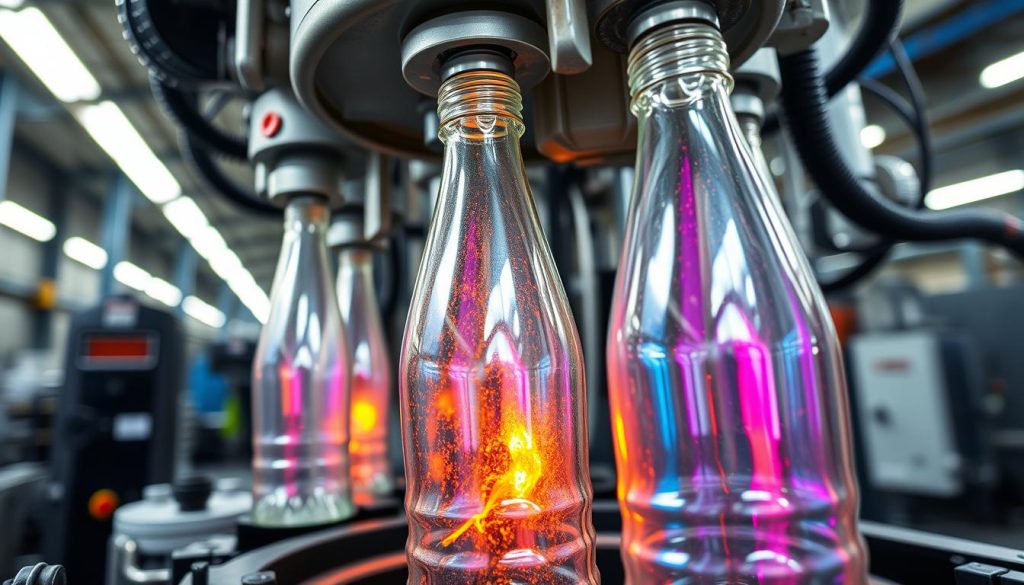
However, there are challenges in blow moulding. Issues include material waste and limited material choices. The costs of starting and maintaining the equipment are high. In a competitive market, finding ways to overcome these challenges is essential. We should consider reusing PET bottles to reduce waste.
Reusing PET bottles helps the environment. It supports a strong recycle cycle. For tips on reusing PET bottles, visit practical uses of PET bottles. This brings environmental benefits.
The PET bottle industry is focussing on being efficient and sustainable. Technology and what customers want are driving changes. The goal is to create innovative designs that are also good for the planet.
Latest Trends in the Blow Moulding Industry
The blow moulding industry is changing fast, thanks to new technology and a focus on being green. Companies like Bekum are creating machines that make production better and create less waste. One good example is the 8-series all-electric machines. They change moulds quickly and use very little energy.
At shows like K 2022, people have seen new machines that are good for the environment. Some of these machines can use recycled materials to make new products. This is a big step towards sustainability.
Innovations in Equipment and Machinery
Digital and automated solutions are making the blow moulding industry more efficient. For example, Magic and FlexBlow are using robots to improve how bottles are made and packed. These changes help make more products faster and keep quality high. Plus, they are looking at ways to use recycled materials in making new products. This shows their dedication to eco-friendly practices.
Environmental Considerations and Sustainability
Environmental issues are very important in blow moulding now. The industry is looking at using materials that are better for the planet, like biodegradable polymers. In South Africa, companies are ahead in using recycled PET. This lessens the need for fossil fuels. Using recycled materials in machines is key to reducing our impact on the environment.
To learn more about these changes, read more at PET Active. These steps are moving us towards a world that takes better care of our planet.
FAQs
What are PET bottle blowing techniques?
PET bottle blowing techniques are methods used to make plastic bottles. They mostly involve blow moulding techniques like Extrusion Blow Moulding (EBM) and Injection Stretch Blow Moulding (ISBM). These techniques help to ensure the bottles’ durability, shape, and features.
How does the blow moulding process work?
In the blow moulding process, we first prepare the preform. Then, we heat it to get an even temperature. Finally, we blow it into a mould with air pressure to get the desired bottle shape and strength.
What is the difference between EBM and ISBM?
With Extrusion Blow Moulding (EBM), molten polymer forms a parison that gets inflated in a mould, perfect for big containers. Injection Stretch Blow Moulding (ISBM) starts with injection moulding to make preforms, then blow moulds them. This method lets us make detailed designs and stronger bottles, commonly for cosmetics and food.
Why is preform heating important?
Preform heating is key for good blow moulding. It makes sure the PET material expands evenly when blown with air. This is critical for bottles to have consistent shapes and no weak spots.
What types of machinery are commonly used in PET bottle manufacturing?
For PET bottle making, machines like the JND-880 and HM-1500 are common. They gave great heat control and are efficient. These machines handle different bottle sizes and designs, for the cosmetics and beverage industries.
How is sustainability integrated into the blow moulding industry?
The blow moulding industry is getting greener by using recycling tech, eco-friendly materials, and making bottles that are easier to recycle or from recycled materials. They aim to reduce environmental harm while still meeting our needs for sustainable products.
Who are the key players in the South African PET bottle manufacturing industry?
South Africa’s PET bottle sector has notable companies known for cutting-edge machines and green practices such as PET Active. These companies are essential in shaping the local market and keeping up with worldwide trends.
