
Blog
PP Bottle vs PET Bottle – Top 5 Differences Between PET And PP Plastic?
Jun
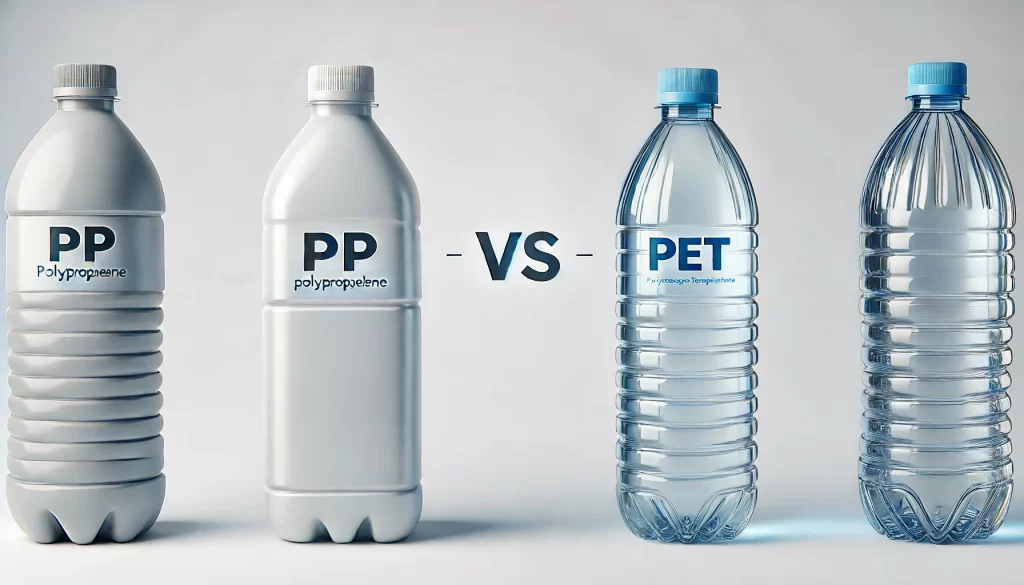
When comparing a PP bottle vs PET bottle, it’s clear that both materials are prevalent, marked with recycling symbols “5” for PP and “1” for PET. But what distinguishes these materials, and which is superior? This article delves into the characteristics and differences between PP and PET, exploring their unique properties and determining which material might be better suited for various applications.
Table of Contents
What Is Polypropylene (PP)?
Polypropylene (PP) is a thermoplastic resin derived from polymerizing propylene. It is a white, waxy material known for being transparent, lightweight, and having a high melting point of 167°C. PP is non-toxic, odorless, and tasteless, with a highly crystalline structure and a density of 0.90–0.91 g/cm³, making it one of the lightest plastics. Depending on the arrangement of its methyl groups, PP is categorized into three types: isotactic, atactic, and syndiotactic polypropylene.
What Is PET?
Polyethylene Terephthalate (PET or PETE) belongs to the polyester family of polymers, known as thermoplastic or saturated polyester. It is produced via transesterification of dimethyl terephthalate with ethylene glycol or through synthesizing bis-hydroxyethyl terephthalate by esterifying terephthalic acid with ethylene glycol, followed by polycondensation. PET is typically a milky white or light yellow, highly crystalline polymer with a smooth, glossy surface. Commonly found in everyday products, PET is categorized into APET, RPET, and PETG.
PP Bottle vs PET Bottle: Physical and Chemical Properties
Understanding the properties of PP and PET is crucial for determining their quality and suitability for different applications. Let’s explore their characteristics from various aspects:
Mechanical Properties
- PP: Excellent rigidity and flex fatigue resistance. Hinges made from PP endure over 70 million folding cycles without breaking but have poor impact strength at low temperatures.
- PET: Superior toughness, minimal wear, high hardness, good creep resistance, fatigue resistance, and dimensional stability.
Thermal Properties
- PP: Good heat resistance; can be sterilized above 100°C and remains undeformed at 150°C without external force.
- PET: Maintains physical and mechanical properties across a wide temperature range, with a service temperature up to 120°C.
Chemical Stability
- PP: Very chemically stable, except against concentrated sulfuric and nitric acids; susceptible to swelling by certain halogenated compounds and high boiling point hydrocarbons.
- PET: Resistant to weak acids and organic solvents, but not to hot water soaking or alkalis.
Electrical Properties
- PP: Excellent high-frequency insulation, maintains electrical insulation in humid environments due to low water absorption.
- PET: Good electrical insulation even at high temperatures and frequencies, though it has lower resistance to corona discharge.
Processing Characteristics
- PP: Good processing characteristics, suitable for injection molding, extrusion molding, blow molding, and foaming.
- PET: Requires thorough drying before processing due to its slow crystallization rate, which otherwise affects product quality.
Comparison of PP and PET Properties
| Property | PP | PET |
|---|---|---|
| Chemical Formula | (C3H6)n | (C10H8O4)n |
| Density (g/cm³) | 0.90 – 0.91 | 1.31 |
| Melting Point (℃) | 164 – 170 | 250 – 255 |
| Water Absorption (%) | 0.03 – 0.04 | 0.06 – 0.129 |
| Tensile Strength (MPa) | 30.0 – 39.0 | 140 – 160 |
| Bending Strength (MPa) | 42.0 – 56.0 | 70 – 100 |
| Elongation at Break (%) | 200 – 400 | 50 – 150 |
PP vs PET: Applications
Polypropylene (PP) is widely used in woven products such as plastic bags, tarpaulins, and ropes. It is also utilized in small household appliances, toys, automotive parts, and pipes due to its high-temperature resistance and recyclability. PP fibers are popular in clothing, carpets, and industrial applications.
Polyethylene Terephthalate (PET) is primarily used for beverage bottles, packaging materials, films, and textiles. Reinforced PET is suitable for electronics, electrical components, and automotive parts, such as coil skeletons and electronic casings. PET’s versatility makes it ideal for various industrial and consumer products.
PP Bottle vs PET Bottle: Health and Safety Concerns
The safety of PP (marked with “5”) and PET (marked with “1”) is a common concern.
PP is odorless, tasteless, and non-toxic, making it safe for food containers, baby bottles, and kitchen utensils as it doesn’t leach harmful substances under normal conditions. PET is safe at room temperature and ideal for beverage bottles due to its transparency and stability. However, PET can release harmful substances like DEHP when exposed to high temperatures or prolonged use. Both PP and PET are food-grade plastics, with PP being heat-resistant and suitable for microwave use. It’s important to use these plastics under appropriate conditions to ensure safety.
How to Choose Between PP and PET
Selecting between a PP bottle vs PET bottle depends on the specific requirements of your product. PET is generally stronger, more durable, and heat-resistant, making it ideal for items needing high durability like bottles and jars. Its transparency also gives it an edge for clear or semi-clear products. On the other hand, PP is softer, lighter, and easier to process, making it suitable for products like bags and clothing. Therefore, the best material depends on whether you prioritize strength and clarity (PET) or lightness and moldability (PP).
FAQs
Which is better, PP or PET?
The choice between PP and PET depends on the application. PET is stronger, more durable, and better suited for transparent packaging like beverage bottles. PP is lighter, more flexible, and easier to process, making it ideal for items like household goods and textiles.
What is the difference between a PET bottle and a PP polypropylene bottle?
PET bottles are more transparent, stronger, and more durable, often used for beverages. PP bottles are lighter and less rigid, suitable for items like baby bottles and food containers.
Which is more expensive, PP or PET?
PET is generally more expensive than PP due to its superior properties, such as higher strength and clarity.
Which is better, PET bottle or plastic bottle?
This depends on the type of plastic. PET bottles are excellent for beverage packaging due to their strength and transparency. Compared to other plastics like PP, PET offers better clarity and durability.
